5 Axis CNC Machining Basics for Custom Precision Parts
Definition: What Is 5-Axis CNC Machining?
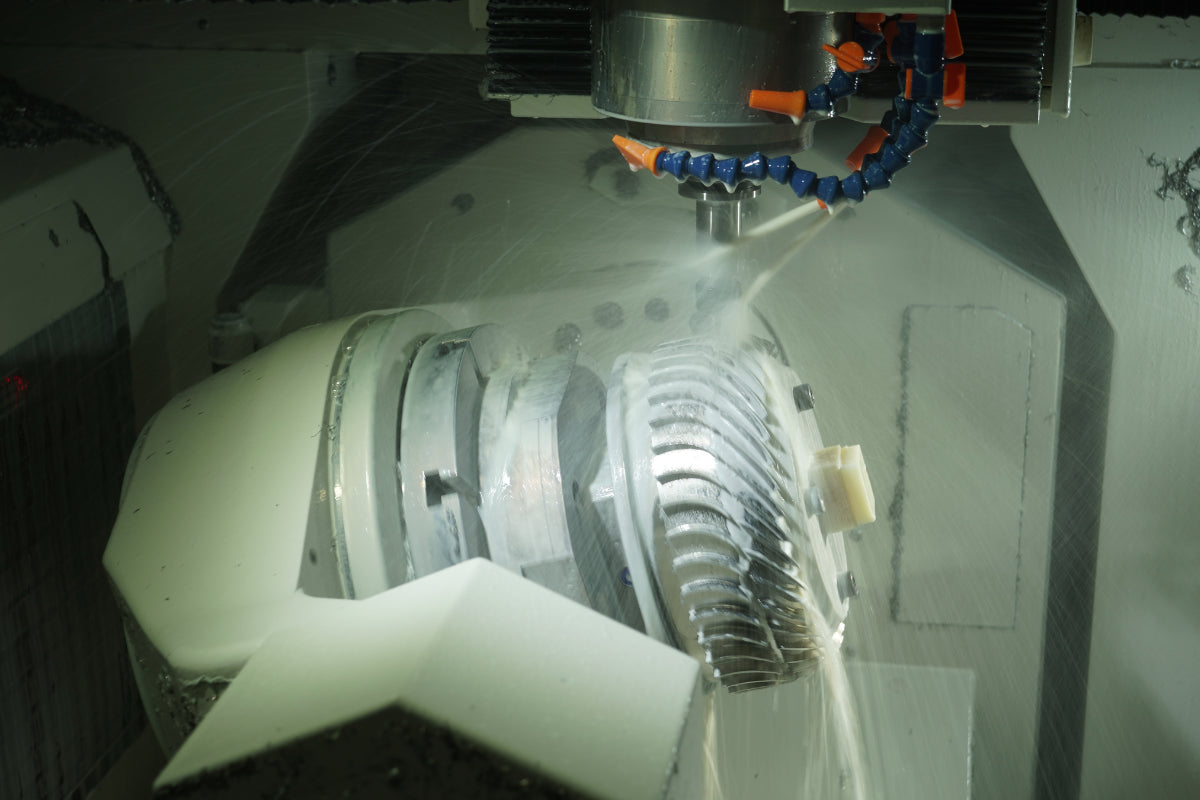
5-axis CNC machining is a subtractive manufacturing process that uses five independent axes of motion to remove material from a workpiece.
A standard 3-axis CNC machine moves the cutting tool along three linear axes:
- X-axis: Left and right
- Y-axis: Front and back
- Z-axis: Up and down
A 5-axis system adds two rotational axes (typically A, B or C axis), letting the cutting tool or workpiece tilt and rotate to approach the part from nearly any angle. This enables machining angled surfaces, compound contours, inclined holes and multi-sided features with far fewer re-fixturing steps.
5-axis machining excels for complex geometries that are inefficient or impractical to produce on 3-axis equipment. Even so, its performance benefits do not always justify the premium cost. Process selection should always be driven by part geometry, tolerance specs, order volume and manufacturability.
How 5-Axis CNC Machining Works
To decide whether 5-axis is right for your project, it is critical to distinguish three common machine modes:
3-Axis CNC Machining
On a 3-axis machine, the workpiece stays fixed while the tool moves along X/Y/Z. To machine other sides or angled features, operators must manually re-clamp and re-align the part. Best suited for simple work: flat brackets, basic housings, open pockets, straight holes and low-complexity plates. It remains the most cost-effective choice for parts that can be completed in one or a few fixed orientations.
3+2-Axis CNC Machining
Also known as indexed or positional 5-axis machining. The rotational axes tilt the workpiece or cutting tool to a fixed angle first. Once locked in position, cutting runs only on the X, Y and Z linear axes. Rotation does not happen during cutting.
Key benefits:
- Access angled surfaces without repeated manual repositioning
- Cut down setup count
- Reduce alignment error introduced by repeated fixturing
- Improve tool reach for inclined features
For most custom precision parts, 3+2 indexing delivers enough flexibility at a much lower cost than full simultaneous 5-axis.
Simultaneous 5-Axis CNC Machining
Full simultaneous 5-axis motion continuously adjusts tool orientation and position while cutting, with all five axes moving in sync. This mode is required for continuous curved surfaces, blended compound angles, impeller blades, turbine wheels, contoured aerospace components and parts with constantly changing tool vectors. It demands advanced CAM programming, simulation and tighter process control.
Quick recap: 3-axis = linear movement only; 3+2 = tilt then cut; simultaneous 5-axis = all axes move together during cutting.
Key Benefits of 5-Axis Machining
The core advantages of 5-axis CNC revolve around better feature access, fewer setups and improved consistency:
- Reduced fixturing and setups: Parts with many angled faces often need multiple clamps and re-alignment on 3-axis machines. 5-axis can machine many surfaces in a single setup, cutting labor and cumulative positioning error.
- Consistent accuracy: Less re-clamping preserves positional relationships between critical holes, mating surfaces and datum features. Note that final accuracy still depends on machine calibration, fixture rigidity, thermal control and inspection routines.
- Superior access to complex geometry: Rotation lets tools reach undercuts, inclined holes, angled pockets and freeform contours that are difficult to reach otherwise.
- Optimized tool orientation: You can shorten tool overhang, maintain stable cutting conditions, get better surface finish and extend tool life where long, slender tools would otherwise be required.
- Simplified custom fixturing: Multi-sided parts often need fewer custom jigs compared to 3-axis workflows. This is especially valuable for one-off prototypes and small batches.
Typical Suitable Parts & Industries
5-axis is targeted at parts with compound angles, curved profiles or multi-sided features that are hard to orient for conventional machining.
表格
| Part type | Why 5-axis adds value |
|---|---|
| Aerospace brackets | Multiple intersecting angled surfaces |
| Impellers / turbine bladed parts | Continuous curved blade geometry |
| Medical instrument components | Intricate compound contours |
| Automotive prototypes | Complex freeform profiles and mounting interfaces |
| Precision enclosures | Many non-parallel machined faces |
| Robotic linkage parts | Angled mating interfaces |
| Custom fluid manifolds | Intersecting inclined ports |
Common industries: aerospace, medical equipment, automotive prototyping, industrial automation, energy and fluid handling.
Important caveat: Not every part in these sectors requires 5-axis. Simple plates, brackets and standard housings are almost always cheaper to produce on 3-axis.
Design Recommendations for 5-Axis CNC
These design rules help you capture 5-axis benefits without inflating your machining budget:
- Skip decorative or non-functional compound curves and angles. Extra geometry raises CAM programming time, cycle time and inspection workload.
- Check tool clearance early: Deep narrow cavities, internal restricted spaces can still cause collision risks and may need special tools or extra setups.
- Separate critical and non-critical tolerances. Reserve tight tolerances only for mating, sealing or load-bearing features.
- Plan clamping and locating surfaces: Complex shapes often need custom fixtures. Leave stable, clean areas for clamping and datum references.
- Choose the right machining mode first: Always evaluate if 3+2 indexed 5-axis can meet your requirements before specifying full simultaneous 5-axis.
We are a CNC machining factory based in China. We offer 3-axis and 5-axis CNC services for complex prototype and small-batch precision components. Our manufacturing team can review your part geometry and help evaluate the appropriate machining approach based on your drawing requirements.
Cost Considerations
5-axis machining carries higher overhead than standard 3-axis work, including premium machine rates, complex CAM programming and longer simulation steps. Even so, total cost is not determined by machine type alone.
Main cost drivers:
- Machine hourly rate & maintenance cost
- Programming and toolpath simulation time (especially simultaneous 5-axis)
- Custom fixture design and fabrication
- Machining cycle time
- Inspection scope: CMM checks for complex contoured features add cost
How to avoid unnecessary 5-axis expense before requesting a quote:
- Can this part be completed on 3-axis?
- Can 3+2 indexed machining reach all required features?
- Does the geometry truly require continuous synchronized tool motion?
- Can the design be simplified without hurting performance?
- Are all tight tolerances functionally necessary?
- Can a revised machining sequence reduce setup steps?
When comparing quotes, evaluate total project cost (setup + programming + machining + inspection), not just the machine hourly rate.
FAQ: 5-Axis CNC Machining
- What is the difference between 3-axis and 5-axis CNC machining? 3-axis machines only move the tool along X, Y and Z linear axes. 5-axis machines add two rotational axes, allowing the tool or part to tilt and rotate. This reduces setups and unlocks complex angled geometry, but it usually comes with higher programming and machine costs.
- When should I use 5-axis CNC machining instead of 3-axis machining? Choose 5-axis when your part has multiple angled surfaces, continuous curved geometry, or features that cannot be accessed efficiently with repeated 3-axis setups. For simple brackets, plates and standard housings, 3-axis machining is usually the more economical option.
- Is 5-axis CNC machining more expensive than 3-axis machining? In most cases yes. Five-axis equipment, programming and operation have higher costs. However, savings from fewer fixtures, less rework and shorter overall lead time can offset the premium for highly complex parts. Always select the process based on your actual geometry and quantity.
Conclusion
5-axis CNC machining delivers unmatched flexibility for complex precision parts by adding rotational motion to the traditional 3-axis workflow. Its strengths include fewer setups, better tool reach and the ability to produce intricate contoured geometry.
Still, full simultaneous 5-axis is overkill for most custom components. For engineers and sourcing teams, the best practice is to match the machining method to your functional needs.
Before sending out an RFQ, review part geometry, tool clearance, tolerance priorities, fixture complexity and order quantity. Choosing between 3-axis, 3+2 indexed and simultaneous 5-axis machining lets you balance precision, quality and manufacturing cost.
-
Posted in
5-axis CNC