CNC Machining for UAV Drone Parts: Design & Manufacturing Guide
Introduction
Unmanned aerial vehicles (UAVs) require lightweight, strong, and dimensionally accurate components to maintain flight stability and operational reliability. From structural frames to motor mounts, every mechanical part contributes to the drone's overall performance.
CNC machining drone components provides the precision and flexibility needed to manufacture complex UAV parts from aluminum alloys, titanium, and engineering plastics.
This guide covers common drone components, material selection, lightweight design, vibration control, and manufacturing considerations for UAV applications.
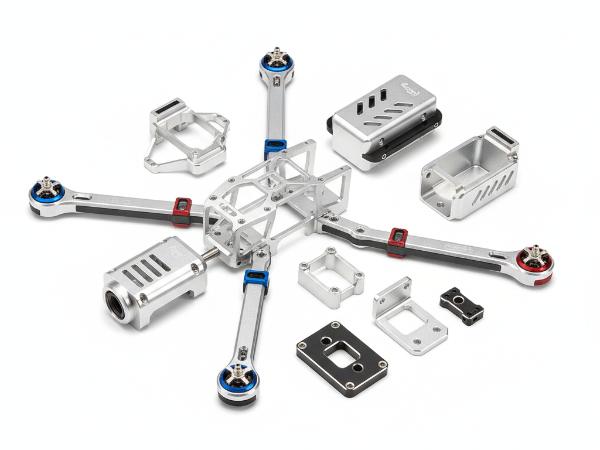
1. Common CNC Machined Drone Components
CNC machining is widely used to manufacture structural and mechanical components for commercial, industrial, and specialized drones.

Common applications include:
|
Component |
Main function |
Key requirements |
|---|---|---|
|
Drone frame plates |
Support the overall structure |
Lightweight, rigid |
|
Motor mounts |
Secure motors to the frame |
Accurate positioning, vibration resistance |
|
Landing gear brackets |
Support landing loads |
Strength, impact resistance |
|
Camera gimbal housings |
Support imaging equipment |
Low weight, dimensional accuracy |
|
Battery mounting brackets |
Secure battery assemblies |
Rigidity, reliable fastening |
|
Sensor housings |
Protect electronic components |
Precision, dimensional stability |
These uav precision machined parts must meet different requirements depending on payload, flight speed, operating environment, and drone configuration.
2. Choose the Right Materials for UAV CNC Parts
Material selection directly affects drone weight, structural strength, vibration behavior, and manufacturing cost.
Aluminum alloys are widely used because they offer a practical balance between strength, low density, and machinability.

|
Material |
Main advantages |
Typical applications |
|---|---|---|
|
Aluminum 6061-T6 |
Lightweight, corrosion-resistant, easy to machine |
Frames, brackets, housings |
|
Aluminum 7075-T6 |
High strength-to-weight ratio |
Motor mounts, structural connectors |
|
Titanium Ti-6Al-4V |
High strength, corrosion resistance |
High-performance connectors |
|
Stainless steel 304 |
Durability and corrosion resistance |
Fasteners, shafts |
|
PEEK |
Lightweight, electrical insulation |
Sensor housings, mounting components |
6061-T6 aluminum is suitable for general drone structures, while 7075-T6 aluminum is often preferred for highly loaded components requiring greater strength.
For weight-sensitive UAV designs, engineers should also consider combining CNC-machined metal interfaces with carbon fiber structural panels.
3. Design Lightweight Drone Components
Reducing structural weight can improve flight endurance, payload capacity, and energy efficiency. However, excessive material removal may reduce rigidity and increase vibration.

Useful lightweight design strategies include:
-
Optimize wall thickness: Maintain sufficient thickness around mounting points and load-bearing areas.
-
Use pocketed structures: Remove material from low-stress regions.
-
Add reinforcing ribs: Improve stiffness without significantly increasing mass.
-
Simplify component geometry: Reduce unnecessary features and machining operations.
-
Optimize weight distribution: Keep heavy components positioned appropriately relative to the drone's center of gravity.
Finite element analysis (FEA) can help identify stress concentrations and evaluate structural deformation before production.
4. Reduce Vibration in Drone Structural Components
Vibration can affect flight stability, motor performance, camera image quality, and sensor accuracy.
Drone components should therefore be designed to withstand repeated dynamic loads generated by motors, propellers, and flight maneuvers.
Consider these recommendations:
-
Improve structural rigidity: Reinforce motor mounts and frame connections to reduce unwanted deformation.
-
Maintain accurate motor alignment: Incorrect mounting positions can contribute to uneven loading and vibration.
-
Avoid weak thin-wall structures: Excessively thin sections may resonate under operating conditions.
-
Control machining quality: Poor surface finish, burrs, and dimensional errors can affect component assembly.
-
Validate through testing: Use vibration testing to identify resonance and structural weaknesses.
Dynamic analysis and proper balancing of rotating assemblies are also important. CNC machining accuracy alone cannot eliminate vibration caused by unbalanced propellers or motors.
5. CNC Machining Tolerances for Drone Components
Different UAV components require different dimensional tolerances depending on their functions.
For example, motor mounts require accurate hole positioning and mounting-face alignment, while non-critical frame covers may use looser tolerances.
Important dimensions include:
-
Motor mounting hole positions and spacing
-
Bearing seats and shaft interfaces
-
Frame connection surfaces
-
Camera gimbal mounting interfaces
-
Fastener holes and threaded features
Engineers should define tolerances according to assembly requirements rather than applying unnecessarily tight specifications to every feature.
For motor mounts, accurate hole patterns, flatness, and perpendicularity are particularly important for consistent installation and alignment.
6. Improve Manufacturing Efficiency Through DFM
Good design for manufacturability (DFM) helps reduce production costs and improve consistency.
When designing drone frame CNC machining components, consider:
-
Use standard cutter-compatible internal corner radii.
-
Avoid excessively deep pockets and narrow channels.
-
Provide adequate tool access for complex geometries.
-
Minimize unnecessary machining setups.
-
Consider surface treatments such as anodizing for aluminum components.
-
Check thread engagement and fastener accessibility.
For complex drone housings and multi-face components, 5-axis CNC machining can reduce repositioning and improve feature alignment. Simpler brackets and plates may be more economical with 3-axis machining.
7. Quality Inspection and Supplier Selection
UAV components should undergo dimensional inspection before assembly, particularly when they affect motor alignment, structural connections, or camera positioning.
Important quality checks include:
-
Dimensional and geometric tolerance inspection
-
Hole position and mounting-face verification
-
Surface finish and burr inspection
-
Material and treatment verification
-
Prototype assembly and vibration testing
When selecting a manufacturer, evaluate CNC machining capabilities, material experience, inspection equipment, surface finishing options, and prototype production flexibility.
Working with a supplier offering custom precision CNC drone components can help engineers assess machining feasibility, material selection, and production requirements.
Frequently Asked Questions
1. What aluminum alloys are widely used for UAV CNC parts?
Aluminum 6061-T6 and 7075-T6 are widely used.
-
6061-T6: Suitable for drone frames, brackets, and housings because of its machinability and corrosion resistance.
-
7075-T6: Offers higher strength and is suitable for motor mounts and heavily loaded structural components.
The choice depends on weight targets, mechanical loads, and manufacturing costs.
2. How to reduce vibration marks on drone structural components?
Use sufficient structural rigidity, appropriate wall thickness, and reinforced mounting areas. Maintain accurate motor mounting positions and avoid poorly supported thin-wall structures.
During machining, optimize cutting parameters, tool selection, and workpiece clamping to reduce chatter marks. Final vibration testing can help identify structural resonance.
3. What tolerance requirements apply to drone motor mounts?
Drone motor mounts typically require careful control of mounting-hole positions, hole diameters, flatness, and perpendicularity.
The exact tolerances depend on the motor manufacturer's specifications, mounting design, and assembly requirements. Engineers should use functional drawings rather than applying unnecessarily tight tolerances to every feature.