CNC Machining vs. 3D Printing: A Comprehensive Guide for Rapid Prototyping
CNC Machining vs. 3D Printing: A Comprehensive Guide for Rapid Prototyping
When bringing a new product to market, rapid prototyping is a critical step in the development cycle. Engineers and product designers need fast, accurate, and cost-effective ways to turn digital CAD models into physical parts for testing and validation.
Today, the two most popular technologies for rapid prototyping are CNC machining and 3D printing. While both are controlled by computers and rely on 3D CAD data, their underlying processes, material capabilities, and ideal use cases are entirely different.
In this comprehensive guide, we will break down the differences between CNC machining and 3D printing to help you choose the most efficient manufacturing method for your next prototyping project.
The Fundamental Difference: Subtractive vs. Additive Manufacturing
To understand which technology is best for your custom parts, you first need to understand how they work.
What is CNC Machining? (Subtractive Manufacturing)
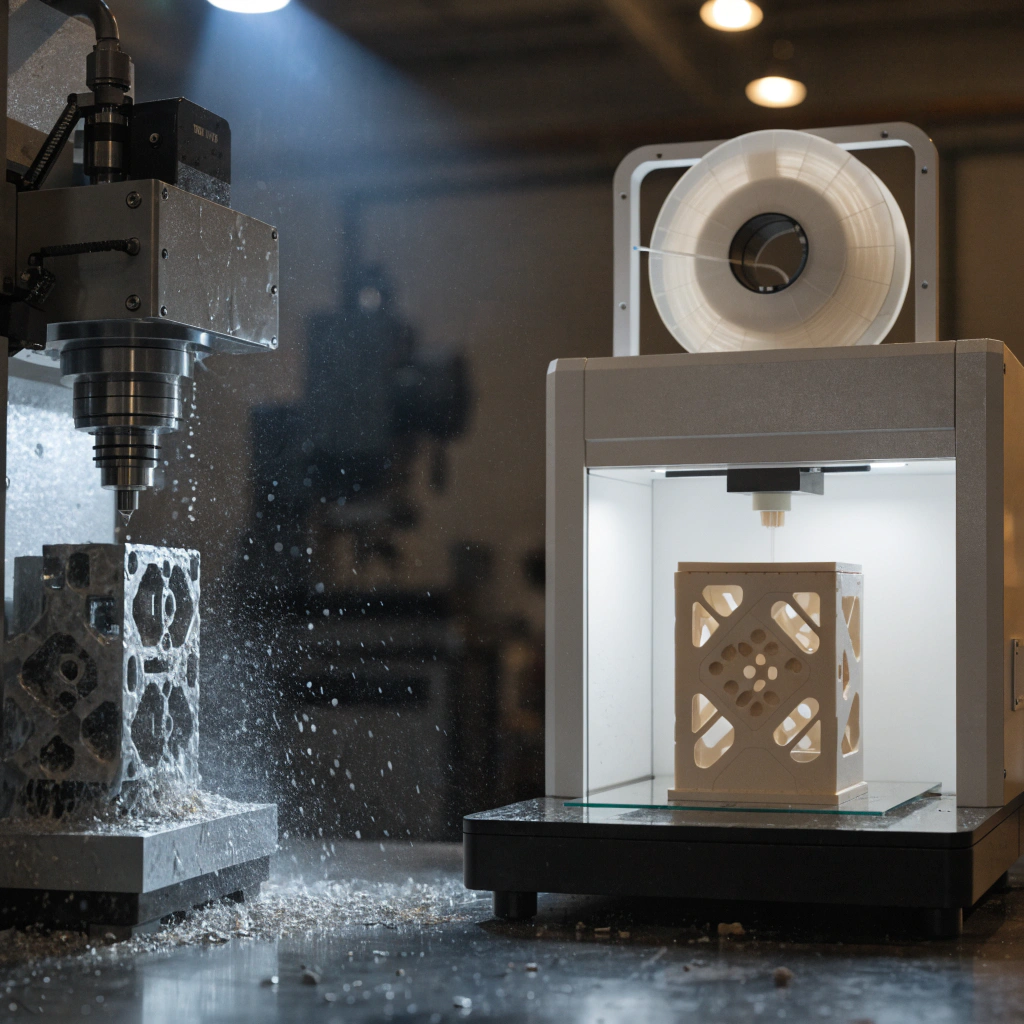
Computer Numerical Control (CNC) machining is a subtractive manufacturing process. It starts with a solid block of raw material (a blank or billet). The CNC machine uses high-speed rotary cutting tools—such as drills, end mills, and lathes—to carve away the excess material until the final part shape is achieved.
What is 3D Printing? (Additive Manufacturing)
3D printing, also known as additive manufacturing, works in the exact opposite way. It builds parts from scratch by adding material one ultra-thin layer at a time. Common technologies include FDM (melted plastic filament), SLA (cured liquid resin), and SLS (sintered powder).
Head-to-Head Comparison: CNC Machining vs. 3D Printing
Below is a quick reference table comparing the key attributes of both rapid prototyping methods.
(SEO Tip: Google loves tables! This helps your site rank for "Featured Snippets".)
1. Material Selection and Properties
If your prototype needs to function exactly like the final mass-produced part, material selection is paramount.
- CNC Machining: Offers an unparalleled range of materials. You can machine functional prototypes out of aerospace-grade Aluminum 7075, Stainless Steel 316L, Titanium, Brass, or high-performance engineering plastics like PEEK, POM (Delrin), and Polycarbonate. The machined part retains the exact mechanical properties of the bulk material.
- 3D Printing: While materials are improving, 3D printing is primarily limited to specialized plastics and resins. Metal 3D printing (like DMLS) exists but is highly expensive and often requires heavy post-machining to achieve tight tolerances.
2. Precision and Tight Tolerances
Does your part need to mate perfectly with other components in an assembly?
- CNC Machining is the undisputed king of precision. Advanced 3-, 4-, and 5-axis CNC mills can routinely achieve tight tolerances of ±0.01mm to ±0.05mm.
- 3D Printing tolerances typically range from ±0.1mm to ±0.3mm. Furthermore, 3D printed parts can warp or shrink during the cooling or curing phases, making them less reliable for high-precision mechanical assemblies.
3. Speed, Volume, and Cost
The most cost-effective method depends entirely on your production volume.
- For 1 to 5 conceptual models: 3D printing is usually cheaper and faster. It requires almost zero setup time—just slice the file and hit print.
- For 10 to 500+ functional parts: CNC machining becomes significantly more cost-effective. While CNC requires initial CAM programming and fixture setup, the actual machining time per part is extremely fast. 3D printing takes the same amount of time to print the 100th part as it did the first.
4. Surface Finish
- 3D printed parts inherently have visible layer lines (stair-stepping effect) due to the additive process. Achieving a smooth finish requires labor-intensive sanding.
- CNC machined parts come off the machine with a smooth, professional "as-machined" finish. They are also immediately ready for advanced surface treatments like anodizing, powder coating, bead blasting, or electroplating
When Should You Choose 3D Printing?
3D printing is an excellent tool for the early stages of product development. You should choose 3D printing when:
- You need a quick "look-and-feel" conceptual model.
- The part has impossible geometries for cutting tools (e.g., complex internal lattice structures or fully enclosed hollow cavities).
- You only need 1 or 2 plastic parts and have a very tight budget.

When Should You Choose CNC Machining?
As your product moves from concept to functional testing, CNC machining becomes essential. You should partner with a CNC machining service when:
- Functional Testing: The prototype must endure real-world physical stress, heat, or fluid pressure.
- Material Authenticity: The prototype must be made from the exact final production material (e.g., real aluminum or steel).
- High Precision: The part requires tight tolerances for bearings, threads, or complex mechanical assemblies.
- Low-Volume Production: You are moving past the prototype phase and need a pilot run of 50 to 1,000 units before investing in injection molding tooling.
Bridging the Gap: From Prototype to Production
Many successful hardware teams use both technologies strategically. They might use 3D printing in week one to check the ergonomics of a design, and then shift to custom CNC machining in week three to create functional metal prototypes for rigorous field testing.
XTJ Group is located in Guangdong, China. It is a technology-based service enterprise specializing in prototype and low-volume production. Relying on high-precision CNC equipment and a professional technical team, our company provides customized solutions for metal and non-metal parts in fields such as automobiles, medical equipment, precision displays, and AI robots.
The company's concept takes "high precision, short lead time, and full-process service" as its core advantages. It covers processes such as CNC Machining, include CNC milling, CNC turning and turning-milling, sheet metal processing, surface treatment. XTJ controls the entire process from drawing design to the end of product delivery, helping customer improve production efficiency and product quality
-
Posted in
3d printing, CNC machined parts, cnc machining, rapid prototyping