CNC Milling vs CNC Turning: How to Choose
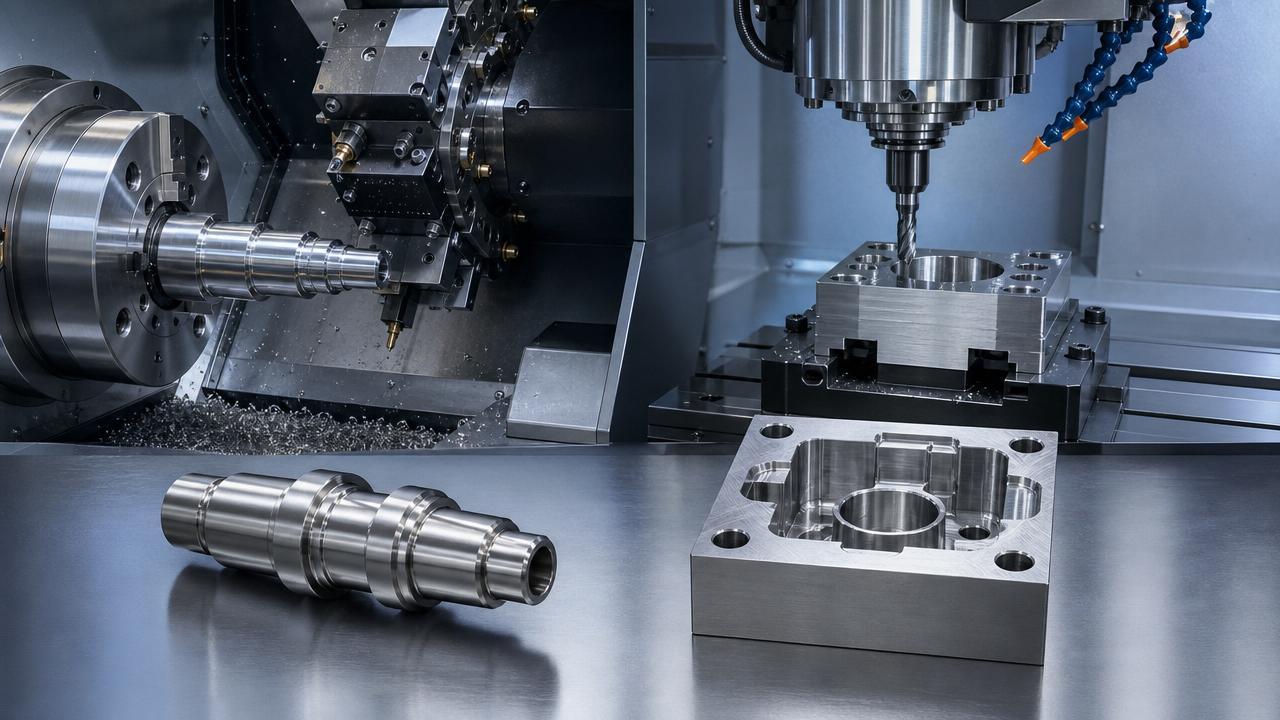
CNC milling and CNC turning are the two core subtractive manufacturing processes widely used in automotive, aerospace, medical, industrial automation and general engineering. While both remove material via cutting tools, they are engineered for distinctly different part geometries. CNC milling works best for prismatic parts, complex pockets, slots and irregular contours. CNC turning is more cost-efficient for cylindrical components such as shafts, bushings and threaded fittings. Selecting the correct process directly improves manufacturability, dimensional accuracy and controls overall part cost.
1. Definition: What Are CNC Milling and CNC Turning?
What Is CNC Milling?
CNC milling uses a rotating cutting tool to remove material from a stationary or repositioned workpiece. The machine moves along X, Y and Z axes; advanced 4-axis and 5-axis mills add rotary axes to reach angled surfaces and intricate profiles. Common milling operations:
- Face milling
- End milling
- Slot milling
- Pocketing
- Drilling and tapping
- Contour machining
Milling is the standard process for aluminum housings, mounting brackets, base plates, custom fixtures and structural components with non-round features.
What Is CNC Turning?
CNC turning runs on a lathe: the workpiece spins, and a stationary cutting tool travels along its surface to cut material away. Common turning operations:
- External turning
- Internal boring
- Facing
- Thread cutting
- Grooving
- Parting off
Turning is optimized for shafts, pins, bushings, threaded connectors and all rotationally symmetric parts.
2. Core Difference: Workpiece Movement, Tool Movement & Suitable Geometry
The key distinction is which element rotates during machining.
表格
| Comparison | CNC Milling | CNC Turning |
|---|---|---|
| Main movement | Cutting tool rotates | Workpiece rotates |
| Workpiece | Fixed or indexed | Spins around its central axis |
| Cutting tool | Multi-point rotating cutter | Single-point stationary tool |
| Typical geometry | Prismatic, irregular shapes | Cylindrical, rotational profiles |
| Common machine | Machining center | CNC lathe / Swiss lathe |
| Typical features | Pockets, slots, flat faces, off-center holes | Shafts, bores, concentric threads, O-ring grooves |
Milling for complex geometries Pick milling when your part has multiple faces, recessed pockets, slots and uneven contours. For example, an automation bracket with mounting holes and cutouts relies on milling’s multi-axis flexibility.
Turning for rotational parts Turning excels at parts built around a central axis. Precision shafts, spacers and cylindrical adapters gain excellent concentricity and consistency when turned.
3. Part Shape Comparison: Best Parts for Milling and Turning
Geometry is your first decision point.
表格
| Part type | Recommended process | Reason |
|---|---|---|
| Aluminum mounting bracket | Milling | Multiple flat surfaces and mounting features |
| Equipment housing | Milling | Pockets, cutouts and irregular outline |
| Precision shaft | Turning | True cylindrical geometry |
| Threaded spacer | Turning | Rotational symmetry + concentric threads |
| Flat fixture plate | Milling | Planar surface and distributed hole pattern |
| Cylindrical bushing | Turning | Matched internal and external diameters |
| Complex threaded connector with flats | Mill-turn | Mix of round and prismatic features |
✅ Choose CNC milling if the part has: Multiple flat or angled surfaces, deep pockets, slots, irregular outer profiles, features spread across several sides, non-cylindrical mounting structures.
✅ Choose CNC turning if the part has: Long cylindrical sections, matched concentric ID/OD, rotationally symmetric profiles, precision threads, grooves and shoulders along one axis.
When a part has both round and non-round features, mill-turn is usually the best solution.

4. Tolerance, Surface Finish, Cost & Lead Time Comparison
Both processes can hold tight precision; achievable results depend on machine capability, tooling, workholding, material and inspection standards.
Dimensional Tolerance Milling performs well for hole position, flatness and geometric relationships between separate features. Turning is superior for controlling diameter, roundness, concentricity and cylindricity on rotary features. Neither process inherently holds tighter tolerances — always define GD&T and critical features clearly on drawings.
Surface Finish Turning delivers smooth, uniform finishes on cylindrical surfaces with properly tuned feeds, speeds and inserts. Milling can also produce fine finishes on flat and contoured surfaces, though tool path marks may remain without a finishing pass. Specify Ra values explicitly for sealing, sliding and mating surfaces.
Cost and Lead Time Turning is generally cheaper for fully rotational parts because the lathe can machine diameters quickly with simple tool paths. Milling often requires more setups and custom fixturing for complex prismatic parts, raising setup and cycle cost. For low-volume custom work, evaluate total cost including programming, fixturing, machining time and inspection, not just machine hourly rates.
5. Combined Mill-Turn Process Explanation
Many fittings and connectors combine turned cylinders with milled flats, cross holes or pockets, e.g. threaded connectors with wrench flats, shafts with transverse holes. Mill-turn machines integrate live tooling and rotary axes to run turning and milling in one setup. Capabilities include:
- External and internal turning
- Cross-hole drilling
- Flat milling
- Slotting
- Threading
- Off-center feature machining
The biggest benefit is fewer re-clamping operations, preserving positional accuracy between turned and milled features and reducing handling risk. Tradeoff: mill-turn equipment and programming cost are higher, so it is most economical when the mixed geometry avoids multiple separate setups.

6. Sourcing Decision Checklist
Before sending out your RFQ, check these items:
- Is the dominant geometry cylindrical or prismatic?
- Does it require multiple faces, pockets or irregular contours?
- Are concentric diameters, threads or roundness critical?
- Does the design need both turned and milled features?
- Are critical tolerances and GD&T clearly marked?
- Material grade, temper and hardness defined?
- Surface roughness, plating or anodizing requirements listed?
- Order quantity confirmed?
- Inspection reports or material certifications required?
Always supply a 2D drawing plus 3D CAD file. This helps suppliers assess fixturing, tool access and select the most cost-effective manufacturing route. For low-volume prototypes, ask your vendor to quote milling, turning and mill-turn options side by side when multiple methods are feasible.
7. FAQ
- What is the main difference between CNC milling and CNC turning? CNC milling spins the cutting tool while the workpiece stays fixed or indexed. CNC turning spins the workpiece against a stationary cutting tool. Milling is for prismatic parts; turning is for rotationally symmetric components.
- Can one machine do both milling and turning? Yes. Mill-turn lathes come with live tooling and extra axes. They can produce parts with cylinders, flats, cross holes and mixed features with fewer setups.
- Which is cheaper, milling or turning? Turning is usually more cost-effective for purely cylindrical parts. Milling is preferred for prismatic shapes. Final price depends on geometry, material, tolerance, setup and batch size.
8. Closing: Choosing the Right CNC Machining Process
CNC milling and CNC turning serve distinct manufacturing needs. Milling handles complex prismatic parts, turning is efficient for precision cylindrical components, and mill-turn bridges designs that require both. Your selection should balance geometry, functional requirements, tolerances, quantity and total production cost.
Factory note: We are a China CNC factory offering milling, turning and mill-turn services for low-volume custom precision parts. Our engineers can review your drawings and recommend the most suitable manufacturing route. Share your 2D drawings, 3D CAD files, material specs and quantity to get a formal CNC machining quote.