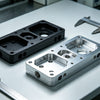
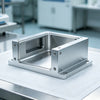
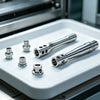
CNC Machined Medical Valve & Fluid Manifold Components for Advanced Fluid Delivery Systems
Introduction
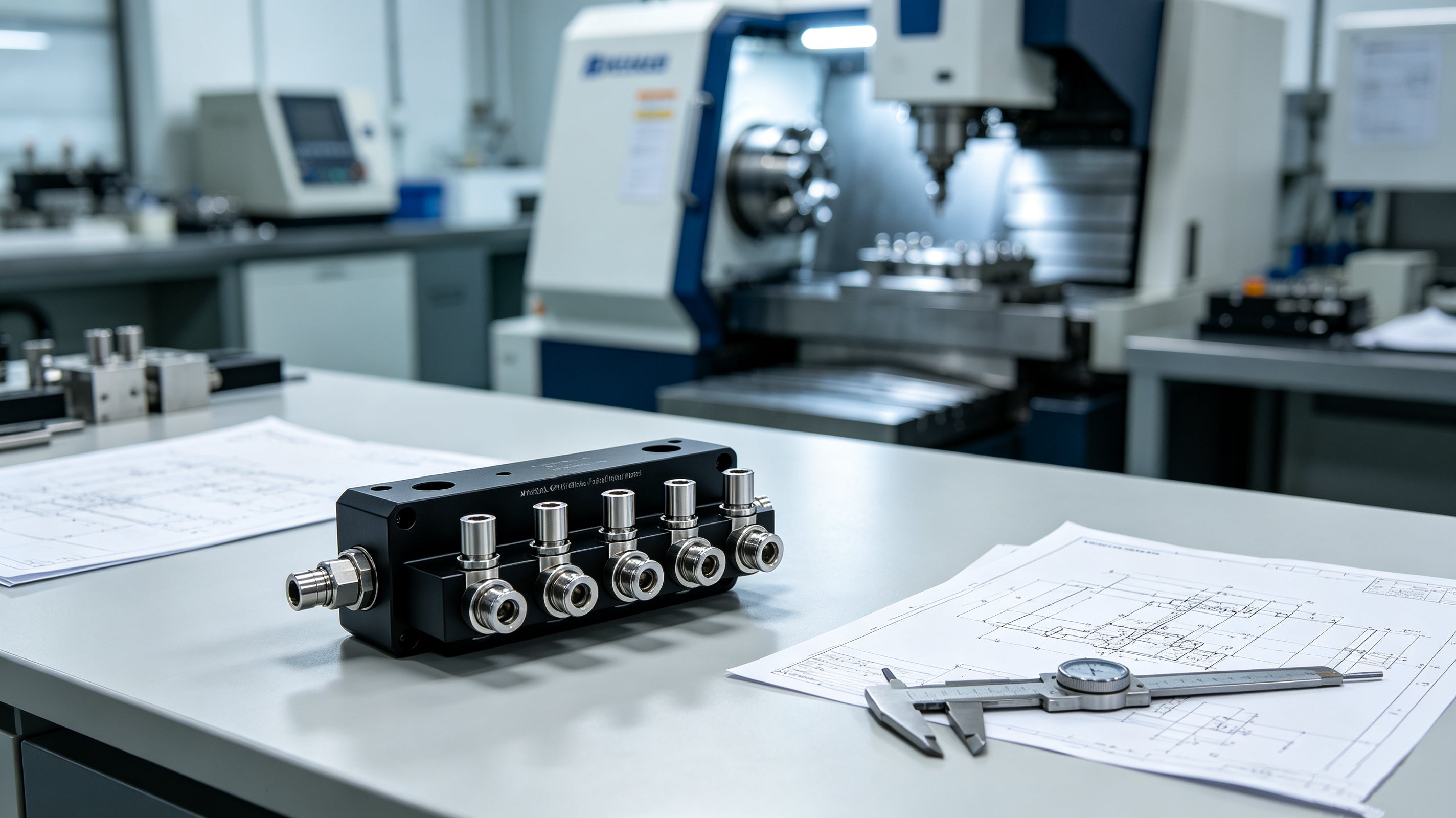
Medical fluid delivery equipment depends on compact valve bodies and manifold blocks to control liquid and gas flow with precise, repeatable performance. These critical components support infusion systems, dialysis machines, clinical analyzers, and portable drug delivery devices.
Unlike standard mechanical parts, medical fluid manifolds feature complex internal passages, intersecting cross-holes, and multi-port layouts that directly impact fluid stability and sterilization safety. Even tiny machining defects such as inner burrs, uneven hole transitions, or offset channels can cause flow turbulence, residual contamination, or sealing failure.
For medical device R&D teams and startups, sourcing reliable medical CNC fluid manifold components is essential during prototype validation and low-volume production. Precision CNC manufacturing ensures stable dimensional accuracy, clean internal flow paths, and fully traceable medical-grade quality.

Unique CNC Manufacturing Challenges for Medical Fluid Manifolds
Medical manifold difficulty lies primarily in internal flow structure machining, not external shape. A single compact manifold block integrates angled passages, cross-drilled holes, threaded ports, and precision sealing surfaces in confined space.
Cross-hole alignment is one of the biggest technical hurdles. Tool deflection and repeated positioning errors create uneven inner intersections, resulting in unstable fluid movement and hard-to-clean dead zones inside the channel system.
Internal deburring is another critical challenge. Traditional deburring methods cannot fully clean deep, curved, or overlapping internal passages. Only specialized CNC tool paths and post-machining cleaning processes can remove micro burrs without altering precision channel dimensions.
For custom medical valve body machining, flatness, concentricity, and thread consistency directly determine long-term sealing performance. Minor tolerance drift will cause liquid or gas leakage during repeated clinical operation cycles.
Additionally, medical manifold prototyping requires high flexibility. Frequent design iteration demands CNC processes that support fast modification while maintaining consistent precision across batches.
Material Selection for Medical Manifold Components (316L Stainless Steel, PEEK)
Material selection determines fluid compatibility, sterilization resistance, chemical stability, and overall device lifespan. Medical fluid manifolds mainly adopt two validated materials: 316L stainless steel and medical-grade PEEK.
316L stainless steel offers superior corrosion resistance, structural rigidity, and pressure resistance. It is ideal for medical valve blocks and high-pressure fluid components exposed to repeated cleaning and sterilization cycles. High-precision 316L stainless steel medical CNC parts ensure stable long-term performance in clinical environments.
PEEK provides unique lightweight advantages, excellent chemical inertness, and electrical insulation. It is widely used for low-pressure fluid assemblies requiring light weight, low thermal conductivity, and non-metallic material properties.
PEEK machining requires strict heat control and optimized cutting parameters to avoid internal stress and channel deformation. Professional CNC strategies guarantee smooth internal flow channels and stable sealing surfaces.
Material selection is determined by working pressure, fluid type, sterilization methods, and structural requirements of the medical device.
Why 5-Axis CNC Suits Complex Medical Fluid Manifold Prototypes & Small-Batch Production
Complex medical manifolds contain multi-angle channels, offset ports, and multi-plane features that cannot be finished efficiently with standard 3-axis machining.
5-axis CNC machining allows full-angle component processing with minimal re-fixturing. It unifies the datum of internal channels, mounting holes, and sealing ports, drastically reducing cumulative setup errors.
For medical prototype development, fewer setups accelerate iteration speed, helping R&D teams verify fluid structure designs faster.
For ISO 13485 CNC medical prototypes, 5-axis machining delivers consistent process repeatability. The same machining parameters can be stably replicated from prototype testing to formal small-batch production.
Compared with mold-based manufacturing, CNC machining requires no upfront tooling cost, making it the most cost-effective solution for customized medical fluid manifold development and low-volume medical equipment production.

Medical Manufacturing Compliance: Surface Finish, Cleaning, and Material Traceability
Medical fluid control components require more than basic dimensional accuracy. Internal surface finish directly affects cleanability, sterilization efficiency, and clinical safety.
Smooth internal channel surfaces prevent residue accumulation and bacterial growth, which is essential for medical fluid system validation. All sealing planes and flow passages must maintain consistent medical-grade surface quality.
Professional post-machining cleaning is mandatory. Micro metal chips, coolant residue, and machining debris must be completely removed from intricate internal channels before delivery.
Full material traceability is required for medical device compliance. Qualified suppliers provide material certification, dimensional inspection reports, process records, and revision-controlled documentation to support customers’ medical registration and quality system audits.
Conclusion
High-performance medical fluid delivery systems rely on precision CNC-machined valve bodies and manifold components. Stable channel accuracy, clean internal finishes, and reliable sealing performance ensure safe and consistent clinical operation.
Professional CNC manufacturing supports medical companies from DFM optimization and prototype verification to scalable low-volume production. With standardized ISO 13485 process control and complete traceability documentation, custom medical CNC fluid manifold components help medical R&D teams accelerate product development and commercialization.
FAQ
1. What are the main machining difficulties of medical fluid manifolds?
Medical manifold challenges focus on cross-hole alignment, internal channel precision, deep-passage deburring, medical-grade surface finish, and consistent sealing accuracy. Complex internal structures make medical fluid components far harder to machine than standard mechanical parts.
2. Which materials are commonly used for medical valve body machining?
316L stainless steel and medical-grade PEEK are the two mainstream materials. 316L suits high-pressure, corrosion-resistant fluid systems, while PEEK is ideal for lightweight, non-metallic, chemically stable medical fluid assemblies.
3. Why choose 5-axis CNC machining for medical manifold prototypes?
5-axis CNC reduces fixture setup errors, improves multi-angle feature accuracy, and processes complex internal channel structures in one unified datum. It delivers higher consistency for medical prototype iteration and small-batch compliant production.