A Practical CNC Machining Design Guide for Better Parts

TL;DR
A CNC machining design guide provides essential rules for optimizing parts for manufacturability, cost, and performance. Effective design for CNC machining involves simplifying geometry, adhering to machine and tool limitations, and making smart material choices. Key principles include adding generous radii to internal corners, maintaining adequate wall thickness, designing holes with standard dimensions, and minimizing complex features to reduce production time and cost.
Understanding the Fundamentals: Core Principles of Design for Manufacturability (DFM)
Design for Manufacturability (DFM) is a critical engineering practice focused on designing parts in a way that makes them as easy and cost-effective to manufacture as possible. When applied to CNC machining, DFM bridges the gap between a digital CAD model and a high-quality physical component. Ignoring these principles often leads to increased costs, longer lead times, and parts that fail to meet quality standards. The core goal is to anticipate and mitigate potential production issues during the design phase, not on the machine shop floor.
Adopting a DFM mindset requires thinking like a machinist. CNC machining is a subtractive process where a cutting tool removes material from a solid block. This fundamental mechanic introduces constraints related to tool access, tool geometry, and material behavior. A design that looks perfect on screen may be impractical or impossible to produce if it requires overly long, thin tools or features that the tool simply cannot reach. By simplifying your design to align with the capabilities of CNC machines, you streamline the entire production workflow.
Several foundational principles guide DFM for CNC machining. Mastering them is the first step toward creating efficient, reliable, and economical parts.
- Simplify Geometry: Complex curves, intricate features, and organic shapes require more complex toolpaths and longer machining times. Whenever possible, design parts with simple, prismatic shapes and features that align with the primary X, Y, and Z axes.
- Standardize Features: Incorporate standard sizes for holes, threads, and corner radii. This allows machinists to use common, off-the-shelf tools, which reduces setup time and tooling costs compared to requiring custom tools.
- Ensure Tool Access: Every feature on your part must be physically accessible to the cutting tool. Deep, narrow pockets or channels can be difficult or impossible to machine effectively. Always consider how the tool will approach and cut each feature.
- Optimize for Fewer Setups: Every time a part must be manually reoriented in the machine (a new setup), it introduces time, cost, and a small potential for error. Designing parts that can be machined from the fewest possible setups is a major cost-saving strategy.
Key Design Specifications: Tolerances, Wall Thickness, and Part Features
Beyond the high-level principles of DFM, specific technical details in your design have a significant impact on manufacturability and final part quality. Paying close attention to tolerances, wall thickness, holes, and internal corners is essential for success. These features are often where common design mistakes occur, leading to unnecessary expense and production delays.
Tolerances
Tolerances define the acceptable range of variation for a given dimension. While CNC machining is known for its high precision, specifying unnecessarily tight tolerances is one of the most common drivers of increased cost. Tighter tolerances may require more machine time, special tooling, and additional inspection processes. Unless absolutely critical for the part's function, it's best to stick with standard tolerances. As a baseline, many machine shops, like those cited by Protolabs, work to a standard tolerance of ±0.005 in. (±0.13mm). Always specify tight tolerances only on critical features and surfaces where form, fit, or function demand it.
Wall Thickness
Thin walls are prone to vibration, warping, and potential breakage during the machining process. This is especially true for plastics, which are less rigid than metals. As a best practice, design walls to be as thick as the part's function allows. According to guidelines from multiple manufacturing experts, a safe minimum wall thickness is 0.8mm for metal parts and 1.5mm for plastic parts. Anything thinner is considered high-risk and may compromise the accuracy and integrity of the final component.
Holes
Hole design is a frequent area for optimization. To keep costs down, design holes with standard drill bit sizes. Using non-standard sizes may require an end mill to interpolate the hole, which is a slower and more expensive process. The depth of a hole is also critical; excessively deep and narrow holes present challenges for chip evacuation and can lead to tool breakage. A good rule of thumb is to keep the hole's depth-to-diameter ratio below 10:1, with an ideal ratio being closer to 4:1 for optimal results, as recommended in the Xometry design guide. Whenever possible, use through-holes instead of blind holes, as they are easier to machine and inspect.
Internal Radii and Corners
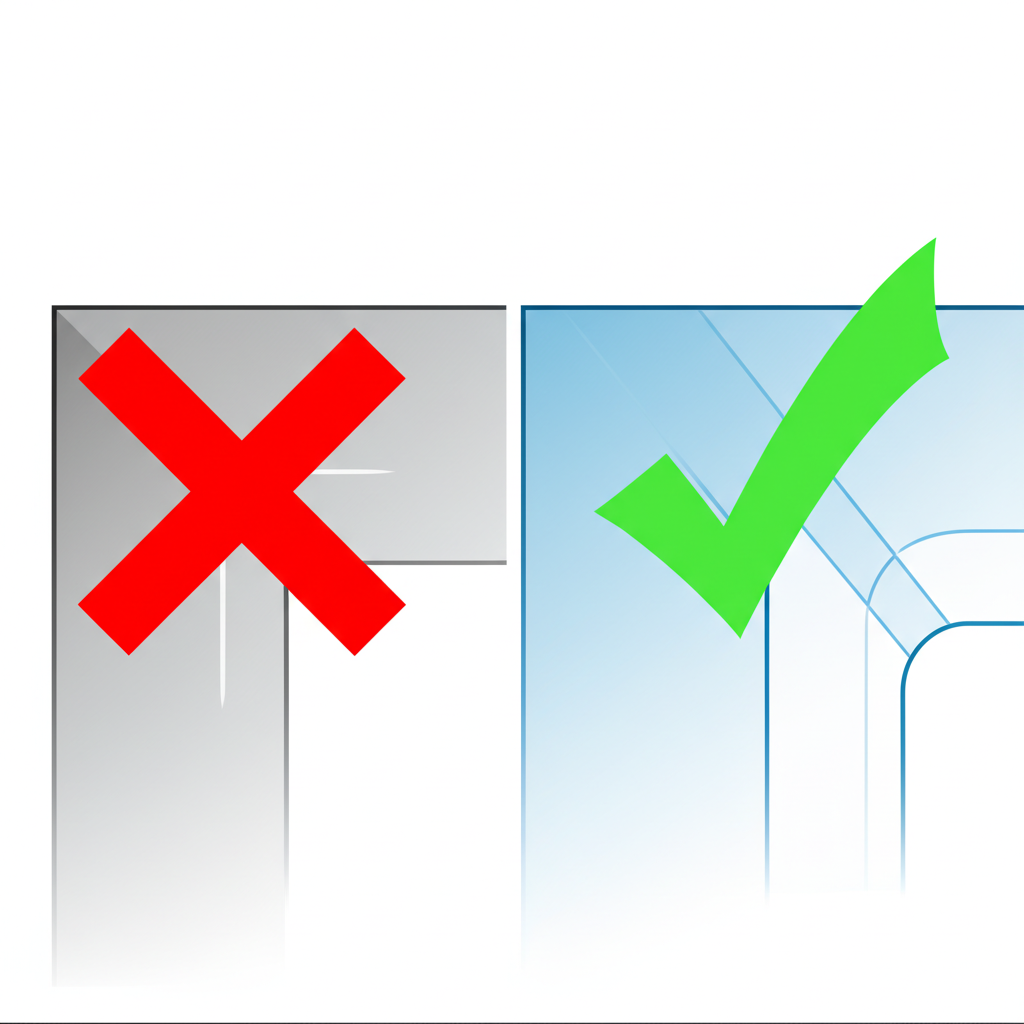
A fundamental constraint of CNC milling is that cutting tools are round, meaning they cannot create perfectly sharp internal corners. Every vertical internal corner in your design will have a radius left by the tool. Attempting to make this radius as small as possible requires very small tools, which are fragile and must cut slowly, drastically increasing machine time. A crucial design rule is to add a corner radius that is at least 1/3 of the cavity's depth. Furthermore, making the radius slightly larger than the tool's radius (e.g., a 4mm radius for a 6mm diameter tool) allows for a smoother, faster toolpath and a better surface finish.
Material Selection Guide for CNC Machining
The material you choose for your part has a profound impact on its functionality, cost, and manufacturability. Softer materials like aluminum and plastics machine much faster than hard materials like steel or titanium, resulting in lower costs and shorter lead times. Your selection should be a balance between the mechanical properties required for the application and the machinability of the material itself.
When working with a specialized provider, you gain access to a wide array of options. For instance, some services offer extensive material choices to meet demanding specifications. If you need high-precision custom parts, a service like XTJ can deliver rapid prototyping and production with advanced 4 and 5-axis CNC machining in over 30 materials, ensuring components meet strict requirements for industries from aerospace to medical. You can learn more about their capabilities at XTJ CNC Machining Services.
Common Metals
Metals are chosen for their strength, durability, and thermal stability. They are ideal for functional prototypes, end-use parts, jigs, and fixtures.
- Aluminum (e.g., 6061, 7075): Offers an excellent strength-to-weight ratio, is easily machined, and has good corrosion resistance. 6061 is a versatile and cost-effective choice for a wide range of applications.
- Steel (e.g., Stainless Steel 304/316, Alloy Steel 4140): Known for its high strength, hardness, and wear resistance. Stainless steels provide excellent corrosion resistance, while alloy steels can be heat-treated for superior toughness. However, steels are harder and slower to machine than aluminum.
- Brass and Copper: Valued for their excellent electrical conductivity and corrosion resistance. Brass is also very easy to machine, often used for fittings and connectors.
Common Plastics
Plastics are a lightweight, cost-effective alternative to metals and are suitable for parts where high strength is not the primary requirement. They offer good chemical resistance and can be self-lubricating.
- ABS: A tough, impact-resistant thermoplastic that is easy to machine and affordable. It's a great choice for general-purpose prototypes and housings.
- POM (Delrin/Acetal): Known for its high stiffness, low friction, and excellent dimensional stability. It's ideal for precision parts like gears, bearings, and bushings.
- Polycarbonate (PC): Offers high impact strength and temperature resistance. Its optical clarity makes it suitable for transparent components, though it can be more challenging to machine for a clean finish.
- Nylon (PA): Provides good mechanical strength, toughness, and chemical resistance. It's often used for parts that experience wear and friction.
| Material Category | Key Properties | Common Applications | Machinability |
|---|---|---|---|
| Aluminum | High strength-to-weight ratio, corrosion resistance | Prototypes, aerospace parts, consumer electronics | Excellent |
| Steel | High strength, hardness, wear resistance | Industrial hardware, automotive components, tools | Moderate to Difficult |
| Plastics (ABS, POM) | Lightweight, low cost, chemical resistance | Housings, gears, jigs, consumer products | Good to Excellent |
| Titanium | Highest strength-to-weight ratio, biocompatible | Medical implants, high-performance aerospace parts | Very Difficult |
Advanced Strategies: Optimizing Designs for Cost and Efficiency
Once you have mastered the fundamental design rules, you can apply more advanced strategies to further reduce costs and accelerate production time. These techniques focus on minimizing machine time, reducing the need for specialized labor, and simplifying the overall manufacturing process. Each optimization can lead to significant savings, especially when producing parts in higher volumes.
-
Minimize Machine Setups
Every time a part is re-fixtured in a different orientation, it adds labor costs and introduces a small amount of potential positioning error. The most cost-effective parts are those that can be machined completely in a single setup, typically on a 3-axis mill. When designing, try to place all features on one or two parallel faces. If features on multiple non-parallel faces are unavoidable, a more expensive 5-axis machine will be required to avoid manual setups.
-
Avoid Complex and 3D Contoured Surfaces
Machining flat, planar surfaces is fast and straightforward. In contrast, complex, doubly-curved, or organic surfaces require a ball-end mill to traverse the surface in many fine, overlapping passes. This process, known as 3D milling, is extremely time-consuming and drives up costs significantly. Unless a complex contour is absolutely essential for the part's function, stick to 2.5D features (pockets and features with flat bottoms) built on flat surfaces.
-
Design with Standard Tools in Mind
As mentioned earlier, standardizing features like holes and threads is crucial. This principle also applies to the radii of internal corners and the width of slots. Design these features to be compatible with common end mill diameters (e.g., 6mm, 10mm, 12mm). This avoids the need for the machine shop to order custom tools and allows them to use their existing, optimized toolsets, saving both time and money.
-
Specify Finishes and Textures Only When Necessary
A standard 'as-machined' finish is the most cost-effective option. Specifying a finer surface finish (lower Ra value) requires slower machining passes and more time. Similarly, post-processing operations like bead blasting, anodizing, or powder coating add extra steps and costs. Apply these finishes only to surfaces where they are functionally or aesthetically required. For text, it is much cheaper to have it engraved (cut into the surface) than embossed (raised from the surface), as embossing requires removing a large volume of surrounding material.
From Design to Production: Key Takeaways
Mastering CNC machining design is a process of balancing functional requirements with the practical constraints of manufacturing. By embracing the principles of Design for Manufacturability, you can create parts that are not only effective but also efficient and economical to produce. Remember to simplify geometries, respect tool limitations by designing generous internal radii and appropriate wall thicknesses, and make informed material choices. These core practices, detailed in resources like the Protolabs Network guide, will consistently lead to better outcomes, reduced costs, and faster turnaround times. Ultimately, a well-designed part is one that moves seamlessly from a CAD model to a finished component, meeting all specifications without unnecessary complexity or expense.
Frequently Asked Questions
1. Why can't CNC machines create sharp internal corners?
CNC milling machines use rotating cylindrical tools to cut material. Because the tool itself is round, it will always leave a radius in any internal corner it machines. To create a sharp internal corner, a different, much slower, and more expensive process like Electrical Discharge Machining (EDM) would be required. For most applications, it is far more practical to design the part with a rounded internal corner that accommodates the cutting tool.
2. What is the ideal depth for a pocket or cavity in CNC machining?
The ideal depth for a pocket or cavity is no more than four times its width (or the diameter of the tool used to cut it). For example, a 10mm wide pocket should ideally be no deeper than 40mm. While depths of up to six times the width are possible, they are considered deep and require slower cutting speeds to manage tool deflection and chip evacuation, which increases machining time and cost.
3. How much do tight tolerances increase the cost of a CNC part?
The cost increase depends on how tight the tolerance is and the complexity of the feature. Moving from a standard tolerance (e.g., ±0.13mm) to a tight tolerance (e.g., ±0.025mm) can double or even quadruple the cost of a part. This is because achieving tighter tolerances requires slower machine speeds, more precise (and expensive) tools, and additional time for in-process measurement and quality control.
4. Is it cheaper to have text engraved or embossed on a part?
It is significantly cheaper to have text engraved (cut into the surface) rather than embossed (raised from the surface). Engraving only requires a small tool to trace the outlines of the characters. Embossing, on the other hand, requires a tool to machine away all the material around each character to make it stand out, which is a much more time-consuming and material-intensive process.
-
Posted in
CNC design, cnc machining, design for manufacturability, DFM, mechanical design