Custom Precision CNC Machining for Industrial Robot Components | Robotic Spare Parts Manufacturing
Industrial robots demand steady repeatability, fast cycle speeds and minimal downtime across automotive assembly, electronics production, intelligent logistics and precision inspection lines. Every single machined component directly defines the overall mechanical performance of robotic equipment.
For automation OEMs and robotics design teams, sourcing qualified robot CNC machined parts is never limited to finding a factory that can copy drawings. The ideal manufacturing partner must fully understand how machining precision, material matching, process stability and complete inspection standards impact robot service performance over its full lifecycle.
As a China-based precision CNC machining factory serving global automation clients, we deliver fully customized robotic structural and functional parts per customer CAD drawings. Our manufacturing system helps OEMs cut assembly risks, unify batch dimensional consistency, and deliver stable quality from prototype validation all the way to mass production.
1. Why High-Precision CNC Machining Is Critical for Industrial Robots
Industrial robots integrate multi-axis moving structures, precision bearings, reducers and servo units into a single mechanical system. Even tiny dimensional deviations on individual components will break the whole motion accuracy chain.
Assembly Interference Caused by Minor Machining Errors
Robot joints are assembled with precision bearings, harmonic reducers, transmission shafts and positioning planes. Once machined dimensions exceed tolerance limits, engineering teams will face recurring troubles:
- Bearing press-fit failure
- Misaligned locating holes
- Excessive shaft clearance gap
- Uneven gear meshing
- Wasted time on secondary assembly adjustment
Leading OEMs prioritize suppliers with mature stable processes to avoid dimensional variation issues at the mass assembly stage, rather than fixing defects after production launch.
High-Speed Operation Amplifies Machining Imperfections
Modern cobots and industrial arms run frequent rapid acceleration under dynamic loads. Tiny geometric flaws will trigger obvious operational defects:
- Persistent mechanical vibration
- Unstable servo output
- Overloaded bearing wear
- Dropped positioning repeatability
- Shortened service life of transmission parts
This standard is especially strict for custom robotic components precision machining, where multiple precision surfaces must maintain fixed positional relations during continuous movement.
Thin-Wall Lightweight Structures Are Prone to Deformation
To balance lightweight design and structural rigidity, robot frames adopt lots of thin ribs, hollow cavities and pocket features. Without targeted machining solutions, these parts easily suffer:
- Wall bending & distortion after clamping release
- Residual stress warping
- Surface tool chatter marks
- Flatness out of tolerance
Controlling deformation relies on optimized cutting paths, dedicated fixture design and staged material removal, instead of simply boosting machine operating speed.
Batch Repeatability Weighs More Than Single Prototype Accuracy
Many workshops can produce one qualified sample prototype, yet struggle to keep identical dimensions across hundreds or thousands of parts.
Procurement teams from automation OEMs evaluate suppliers by these core standards:
- Stable standardized processing flow
- Scientific tool wear monitoring & replacement cycle
- Reusable high-precision fixtures
- Complete statistical process control
- Unified full-batch inspection criteria
Trusted industrial robot spare parts CNC manufacturing focuses equally on long-term repeatability and absolute single-part precision.
2. Key Materials for CNC Machined Robot Parts (Strength & Lightweight Balance)
Material selection determines robot weight, structural rigidity, corrosion resistance, thermal stability and long-term durability. We match raw materials according to each robot’s working scenario, load range and expected service cycle.
Aerospace-Grade Aluminum Alloy for Lightweight Robot Frames
Aluminum alloys remain the mainstream material for lightweight robotic structures, with our most frequently processed grades: 6061-T6, 6082 and 7075-T6.
Material strengths:
- Excellent machinability
- Outstanding strength-to-weight ratio
- Natural corrosion resistance
- Stable dimension after processing
- Compatible with various anodizing treatments
Main application scenarios:
Robot arm frames, cobot outer shells, servo mounting plates, sensor brackets and lightweight aluminum robot structural parts.
For robots requiring frequent fast acceleration, lighter structural weight effectively reduces motor load and upgrades overall motion efficiency.
Titanium Alloy for High-Load Robotic Joint Components
Titanium alloy stands out for projects requiring high tensile strength while controlling overall equipment weight.
Typical use cases:
High-load rotary joint cores, precision connecting linkages, aerospace automation equipment and medical robotic systems.
Compared with aluminum alloy, titanium features superior fatigue resistance, wear resistance and low thermal expansion rate. Although titanium machining demands slower cutting speeds and strict heat control, it delivers reliable performance for rigorous robotic joint components machining orders.
Carbon Steel & Alloy Steel for Heavy-Duty Robot Bases
Heavy industrial robot equipment needs rigid supporting structures to absorb continuous dynamic impact loads, making carbon and alloy steel the optimal choice.
Main applications:
Robot base plates, large mounting platforms, heavy load support frames and automation line equipment foundations.
Core advantages: ultra-high rigidity, strong impact resistance and stable fatigue performance. We can apply customized heat treatment to further boost surface hardness and wear resistance before finish machining, per customer demands.

3. Ultra-Tight Tolerance Machining for Robotic Functional Parts
Core functional assemblies of robots demand far stricter precision than standard mechanical components, with critical features holding stable ±0.01 mm tolerance for:
Bearing mounting bores, reducer fitting housings, servo positioning planes, transmission shaft matching surfaces and precision assembly interfaces.
Consistent high precision comes from full-process standardized control, not just high-end machine tools.
Stable 5-Axis Multi-Setup Machining
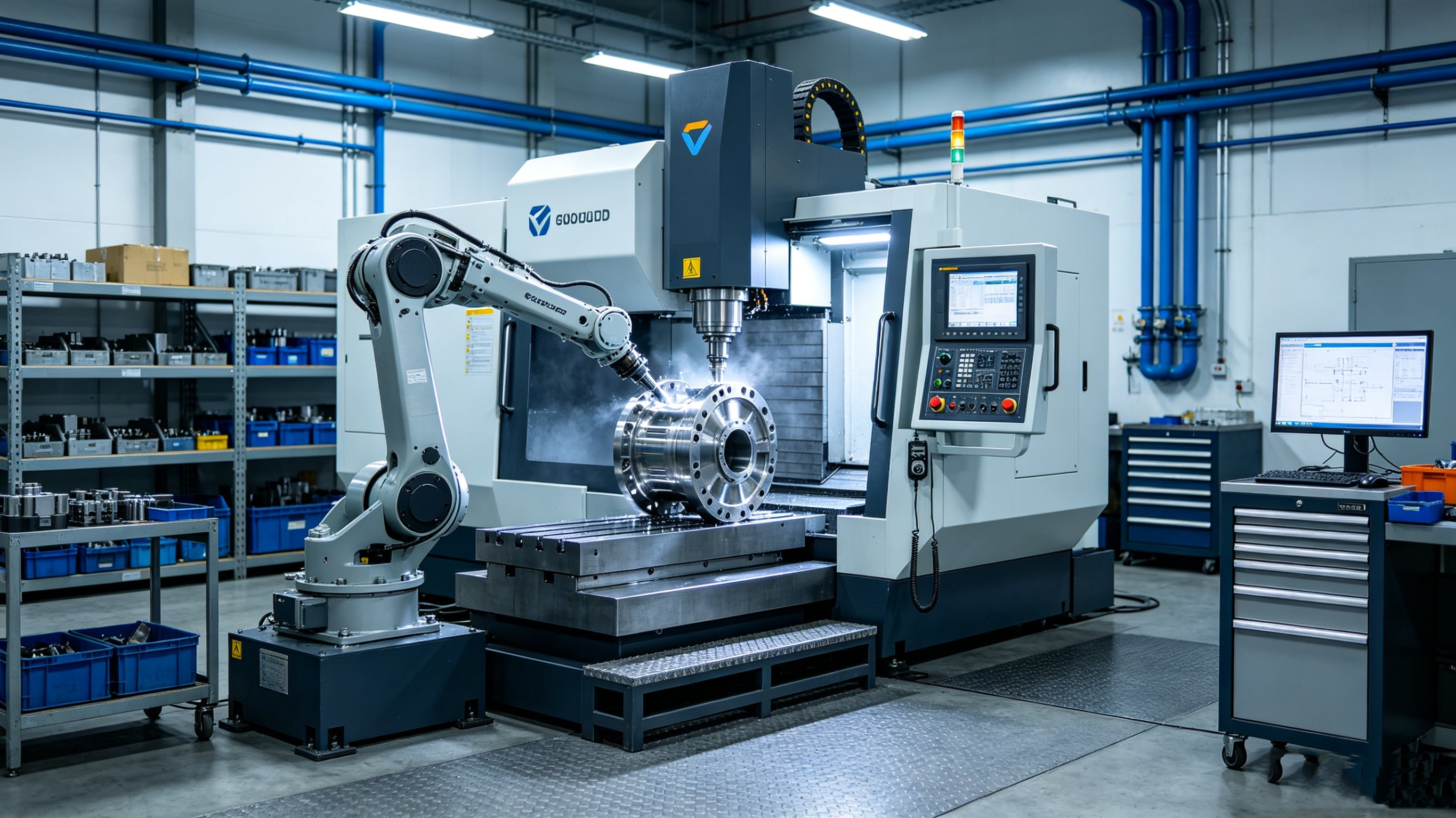
We adopt 5-axis CNC for automation equipment components to finish multiple complex geometric surfaces in one single clamping operation.
Core advantages:
- Eliminated cumulative positioning errors from repeated fixture changes
- Consistent geometric tolerance between intersecting features
- Uniform surface finish across the whole part
- Shorter overall production lead time
Single-clamping processing is irreplaceable for robot housings integrated with dozens of interrelated precision features.
Targeted Anti-Deformation Solutions for Thin-Wall Parts
Robot lightweight housings contain numerous thin walls and hollow pockets prone to bending. Our standardized anti-deformation workflow includes:
- Balanced rough machining to remove most material evenly
- Intermediate stress relief treatment for extra-thin structures
- Separate semi-finishing and final finishing stages
- Custom supporting fixtures to disperse clamping force
- Thermal stabilization before final precision cutting
This complete system guarantees flatness and dimensional stability for tight tolerance robotic aluminum parts.
Real-Time Tool Wear Management for Batch Consistency
Long-run mass production relies on controlled tool aging. We set fixed tool replacement cycles and monitor cutting conditions throughout production to avoid:
- Drifted hole inner diameters
- Uneven surface roughness
- Uncontrolled corner radii
- Deviated feature positioning
Process parameter consistency is the foundation of reliable repeated batch manufacturing.

4. Common Custom CNC Robot Components We Produce
Every automation production line uses a wide range of custom precision machined mechanical parts. We fully manufacture the following products based on client 2D drawings and 3D CAD files:
- Robot joint housings
- Harmonic reducer enclosures
- Precision bearing seats
- Robot arm connecting blocks
- Robotic gripper fingers & end effector plates
- Servo motor mounting brackets
- Sensor installation bases
- Heavy-duty robot support frames
- Automation line connecting brackets
- Cable fixing frames
- Vision camera mounting stands
- Pneumatic actuator housings
- Linear motion fixture locating blocks
For mobile intelligent equipment, we also provide complete structural parts for AGV frame CNC manufacturing:
Chassis side frames, battery supporting structures, wheel mounting bases, suspension brackets and drive module housings.
All products are custom-built to customer design files; we do not supply standard off-the-shelf robotic spare parts.
5. CNC Processing & Surface Finishing for Robotic Parts
Surface finishing directly impacts component wear resistance, anti-corrosion performance, assembly smoothness and exterior appearance. We select matching treatments based on each part’s working environment and functional requirements.
Hard Anodizing
Ideal for aluminum robot components that need: higher surface hardness, enhanced wear resistance, long-term corrosion protection and insulation performance. Widely used on lightweight robot arms and structural housings.
Sandblasting
Creates uniform matte texture, removes tool machining marks and improves adhesion for subsequent anodizing coloring processes.
Precision Deburring
Burr-free edges are mandatory for robotic assemblies to prevent assembly jams, cable abrasion, operator scratches and local stress concentration. We adopt mechanical or manual deburring solutions based on part geometry complexity.
Black Oxide Treatment
Suitable for carbon steel robotic parts, offering mild rust protection, low light reflection and zero dimensional change after treatment.
Dynamic Balancing for High-Speed Rotating Parts
Rotary components running at high operational speeds require dynamic balancing post-machining, including drive shafts, coupling assemblies and rotating fixture hubs. Balancing effectively cuts running vibration and extends bearing service life.

6. Strict QC Inspection Process for Robotic Machined Components
We implement full-cycle quality verification throughout production, rather than only conducting spot checks after parts finish machining, to meet global export quality standards and customer engineering audit demands.
Incoming Raw Material Inspection
All raw materials get full verification before entering production: material grade confirmation, surface condition inspection, heat treatment record checking and original material certification filing to guarantee full batch traceability.
Mid-Production Sampling Inspection
Operators and dedicated QC staff conduct regular sampling during machining, focusing on critical dimensions, hole position accuracy and surface finish to adjust parameters timely before mass defective products form.
CMM Full Dimensional Testing
All core robotic functional components undergo complete coordinate measuring machine inspection, covering position tolerance, flatness, perpendicularity, true position and full contour measurement. Inspection frequency follows drawing specifications and client customized demands.
Complete Quality Documentation Support
Overseas buyers often require supporting inspection paperwork with shipments, and we can provide:
Material test certificates, full CMM dimensional inspection reports, surface treatment qualification documents and heat treatment records (if applicable). These files simplify incoming quality control at your factory.
Export Shockproof Protective Packaging
Precision machined robot components need dedicated protection for long-distance international transport: independent anti-scratch wrapping, shock-absorbing foam separators, anti-rust film for steel parts and reinforced export cartons or wooden cases to eliminate collision damage during transit.
7. FAQ – Custom CNC Machining for Robot Components
-
What CAD drawing formats do you accept for quotation & production?We support 2D engineering PDF drawings plus mainstream 3D files including STEP, STP, IGES and X_T, which help our engineers fully capture all hidden machining features.
-
Can your factory stably hit ±0.01 mm tolerance?Yes, we can hold ±0.01 mm precision on eligible features. Our team completes a full DFM manufacturability review before quoting, evaluating part geometry, material and processing limits to confirm achievable tolerance standards.
-
What materials are most widely used for robot component manufacturing?Aluminum alloys, stainless steel, carbon/alloy steel and titanium alloy cover over 90% of our robotic part orders, chosen according to load, weight and working environment requirements.
-
Do you support prototype small-batch trial runs before mass manufacturing?Absolutely. Most automation clients start with prototype verification, then move to pilot small batches before full-scale mass production. We match flexible production capacity for every project stage.
-
Are all surface finishing services available in-house?We provide a full suite of post-processing: standard/hard anodizing, sandblasting, polishing, black oxide coating and full deburring, all processed by qualified cooperative workshops under our unified quality control standards.
-
How do you guarantee consistent dimensional accuracy across large batches?Uniform fixture solutions, fixed cutting parameters, scheduled tool replacement, mid-process sampling inspection and final full dimensional testing work together to stabilize long-run production quality.
-
Can you attach official inspection reports to each shipment?We provide customizable quality documents including material certificates and full CMM inspection reports as required by your purchasing or engineering department.
-
Will you offer free DFM analysis before production starts?Yes. Our engineering team conducts free manufacturability evaluation for all incoming designs, optimizing tolerance layout, machining feasibility and material selection to reduce potential production risks for your robotic projects.
Conclusion
Selecting a reliable CNC machining supplier for robotic components goes far beyond comparing unit prices. Long-term stable manufacturing cooperation relies on consistent dimensional precision, scientific material matching, standardized processing workflows, complete inspection systems and unified batch quality control.
No matter your project covers robot CNC machined parts, custom robotic components precision machining, industrial robot spare parts CNC manufacturing, robotic joint components machining, lightweight aluminum robot structural parts, tight tolerance robotic aluminum parts, 5-axis CNC for automation equipment components or AGV frame CNC manufacturing, early engineering communication will greatly lower production risks and boost overall manufacturing efficiency.
We accept 2D engineering drawings and all mainstream 3D CAD files for prototype development and volume production. Complete material certificates, full dimensional inspection reports and other custom quality paperwork can be delivered alongside finished orders.
If you are developing new automation equipment or optimizing existing robot assembly structures, send your design files to our engineering team for a free DFM review and formal quotation. We normally send detailed feedback within 24–48 hours.