Professional CNC Precision Machining for Medical Device Components | Custom Medical Parts Manufacturing
Professional CNC Precision Machining for Medical Device Components | Custom Medical Parts Manufacturing
Medical device manufacturing is one of the most rigorous and regulated industries in the world, where precision, consistency, and material safety directly impact patient outcomes and market approval. Unlike general industrial components, every medical-grade part demands strict dimensional stability, flawless surface quality, and full manufacturing traceability. For medical OEMs, R&D teams, and medical equipment contractors, choosing a reliable supplier for medical device CNC machining is critical for product safety, regulatory compliance, and long-term production stability.
With the rapid growth of minimally invasive surgery, diagnostic imaging, dental restoration, and wearable medical equipment, the demand for custom medical CNC parts has risen sharply worldwide. However, many global buyers still face common challenges, including inconsistent tolerances, unstable surface finishes, poor biocompatibility control, and suppliers lacking standardized medical manufacturing workflows.
This is where professional precision CNC machining adds irreplaceable value to medical device production.
1. Why CNC Machining Is Indispensable for Medical Device Manufacturing
Medical components require ultra-high precision and batch-to-batch consistency that traditional casting, stamping, or manual processing cannot achieve. Modern precision medical component machining relies on CNC technology to deliver repeatable accuracy, fully traceable production data, and flexible material adaptability for regulated medical environments.
CNC machining plays a core role in manufacturing critical functional structures such as:
-
High-precision joint structures for surgical instruments
-
Smooth implant seating and fitting surfaces
-
Micro fluid channels and control structures for diagnostic devices
-
Shockproof and dustproof housings for electronic medical equipment
Compared with traditional processing methods, CNC machining adopts fully digital toolpath programming, effectively eliminating manual errors and ensuring identical dimensional accuracy from prototyping to mass production. For medical OEMs, this stable consistency greatly shortens product verification cycles and accelerates FDA and CE regulatory approval processes.
2. Strict Industry Standards for Medical CNC Machining (ISO 13485, FDA Compliance)
Medical-level machining is never simply about precision processing — it relies on standardized, controllable, and traceable manufacturing systems.
Factories with mature ISO 13485 medical machining capabilities establish complete quality management systems covering material admission, formal processing, surface treatment, and finished product inspection. Although ISO 13485 does not certify individual parts, it verifies the stability and standardization of the entire production system behind each component.
Our medical manufacturing compliance system includes standardized controls as follows:
-
Complete material batch tracking and heat number traceability
-
Full-process documented machining parameters and process records
-
Regular tool calibration and wear detection mechanisms
-
First Article Inspection (FAI) for every production batch
-
Lot-based dimensional inspection data archiving
For customers targeting the U.S. and European markets, all FDA compliant medical parts we produce strictly follow medical-grade material sourcing standards and process consistency requirements, fully meeting international medical regulatory expectations.
3. Best Biocompatible Materials for Custom Medical CNC Components
Material selection determines the safety, durability, and sterilization compatibility of medical components. All materials applied in medical machining must pass biocompatibility tests and adapt to high-temperature sterilization, chemical disinfection, and long-term human contact environments.
3.1 316L Stainless Steel for Surgical & Implant Components
Medical-grade 316L stainless steel is the most widely used material for surgical and auxiliary implant parts, featuring excellent corrosion resistance, oxidation resistance, and stable biocompatibility.
Typical applications include surgical tool shafts, orthopedic positioning fixtures, temporary implant structures, and endoscopic equipment shells. Through refined high-speed milling and precise finishing, we can control the surface roughness of 316L parts stably between Ra 0.4–0.8 μm, adapting to repeated autoclave sterilization without surface deterioration.
3.2 Titanium Alloy for High-Stability Medical Implants
Grade 5 titanium alloy (Ti-6Al-4V) dominates titanium medical CNC parts manufacturing due to its ultra-high strength-to-weight ratio, low density, and excellent human tissue compatibility. It is widely used in bone fixation parts, dental implant brackets, and load-bearing surgical implants.
Titanium machining is technically difficult due to low thermal conductivity and easy tool wear. We adopt low-speed high-torque cutting, high-pressure cooling, and special wear-resistant tooling to avoid thermal deformation, stably controlling key tolerance within ±0.01–0.015 mm to ensure implant assembly accuracy and safety.
3.3 Medical-Grade PEEK for Lightweight Precision Components
PEEK medical component manufacturing is increasingly popular for high-end medical devices due to the material’s radiolucency, chemical stability, and lightweight advantages. It will not interfere with X-ray and MRI imaging, making it ideal for diagnostic and rehabilitation medical structures.
We process medical-grade PEEK for spinal implant gaskets, dental healing caps, imaging equipment shells, and surgical tool insulation parts. Adopting low-heat milling and segmented chip removal technology effectively avoids thermal deformation and surface cracking, ensuring long-term structural stability of PEEK precision parts.

4. Ultra-Tight Tolerance Machining Capabilities for Medical Devices
Modern medical equipment is developing toward miniaturization, precision, and integration, putting forward extremely high requirements for component tolerance control. Our factory’stight tolerance medical machining 0.01mm capability fully meets the precision needs of high-end medical assemblies.
In formal batch production, we stably achieve:
-
Standard functional tolerance: ±0.01–0.02 mm
-
High-precision assembly tolerance: ±0.005–0.01 mm
-
Sealing and flatness precision: within 0.005 mm

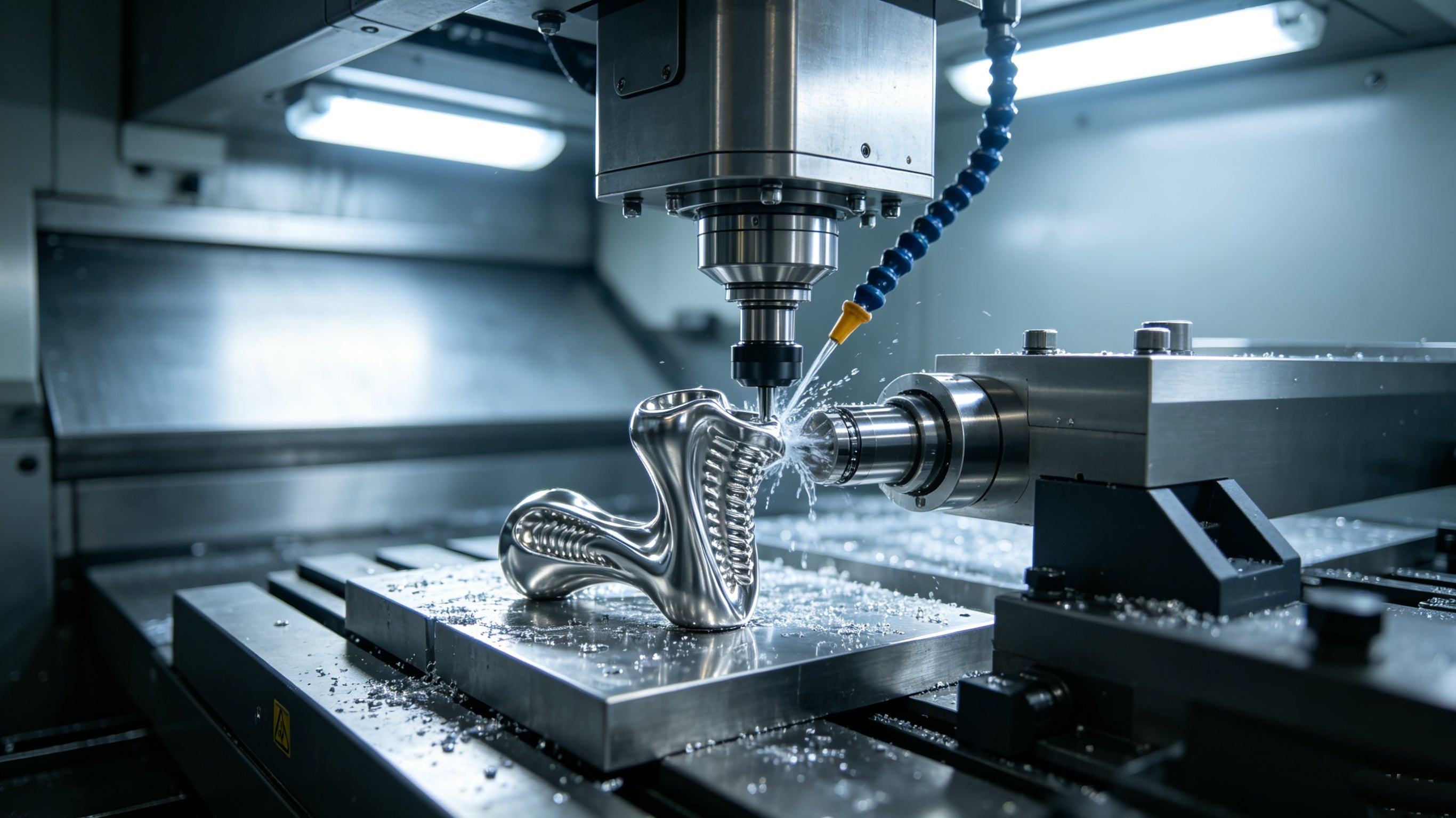
Equipped with 5-axis CNC machining centers, we complete complex curved surfaces, multi-angle structures, and micro-groove processing in one clamping, effectively avoiding cumulative tolerance errors caused by multiple positioning. This precision is essential for minimally invasive surgical motion systems, implant fitting surfaces, and medical fluid control structures that allow zero leakage.
5. Common Custom Medical CNC Parts We Manufacture
As a professional manufacturer of custom medical CNC parts, we provide one-stop precision processing solutions covering medical product prototyping, sample verification, and mass batch production.
Our mainstream medical CNC components include:
-
Surgical instrument handles, shells and precision connecting parts
-
Diagnostic equipment frames, fixed brackets and structural accessories
-
Dental medical equipment precision functional parts
-
Implant fixation accessories and auxiliary structural parts
-
Laboratory instrument shells, fluid control and micro-channel parts
We support customized processing according to customer 2D drawings and 3D CAD files, and provide professional DFM manufacturability optimization suggestions to help customers reduce production costs and improve product yield without affecting performance.

6. Medical CNC Machining Quality Control & Clean Processing Standards
Medical precision processing quality control covers the whole process from material admission to finished product delivery, not limited to simple dimensional detection.
Our complete quality control system includes:
-
Strict incoming material inspection and material certificate verification
-
On-process real-time size detection and parameter adjustment
-
CMM three-dimensional precision detection and flatness verification
-
Professional surface roughness testing and appearance inspection
For high-precision and highly clean medical parts, we implement dust-proof and pollution-free processing and transfer standards to avoid particle contamination. Meanwhile, we provide complete batch traceability reports, material certification files, and finished product dimension inspection reports to support customers’ medical product registration and regulatory review.
We support multiple medical-grade surface treatments such as passivation, electropolishing, precision polishing and medical anti-corrosion treatment to meet different medical application scenarios.
7. FAQ About Medical Device CNC Machining
Q1: What is the smallest tolerance you can achieve for medical CNC parts? We stably maintain ±0.01mm standard tolerance for conventional medical precision parts. For ultra-precision assembly structures, we can achieve a high precision of ±0.005mm under optimized processing conditions, depending on material and structural complexity.
Q2: Do your medical machining services comply with ISO 13485 standards? Yes. We fully follow ISO 13485 medical quality management specifications in production, including complete process documentation, material traceability, batch inspection and quality record archiving, meeting international medical manufacturing standard requirements.
Q3: Can you process high-precision titanium medical components? Absolutely. We have long-term processing experience in Grade 5 titanium alloy medical parts. With professional low-heat cutting technology and special tool matching, we effectively solve titanium processing deformation problems and ensure stable batch precision.
Q4: Do you provide medical-grade PEEK customized processing? Yes. We provide customized processing services for medical implant-grade and medical equipment-grade PEEK materials, strictly controlling processing temperature and cutting parameters to ensure no deformation, no cracking and stable product quality.
Q5: What surface finishing options are available for medical components? We provide medical passivation, electropolishing, high-precision mirror polishing, matte finishing and medical anti-corrosion treatment to meet sterilization, biocompatibility and appearance requirements of different medical devices.
Q6: Can you support both prototype and mass production orders? Yes. We support the whole production cycle from small-batch prototype proofing, pilot batch testing to large-scale mass production, maintaining consistent precision and quality in all stages.
Q7: Can you provide inspection reports and material certificates? Yes. We can provide official material certification, batch traceability reports, first article inspection reports and full dimension test reports, which can be directly used for customers’ medical product filing and regulatory audit.
Final Words: Reliable CNC Machining Partner for Medical Device OEMs
Medical device manufacturing represents the highest standard of precision processing and quality management in the industrial field. Stable precision, standardized process, complete quality documents and reliable material safety are the core competitiveness of qualified medical parts suppliers.
We focus on high-precision medical device CNC machining, providing one-stop customized manufacturing solutions for global medical equipment OEMs and engineering teams. Our services cover 316L stainless steel, titanium alloy, medical PEEK and other biocompatible material processing, with stable tolerance up to 0.01mm, supporting prototype development, sample verification and scalable mass production.
If you are looking for a stable, compliant and professional manufacturer ofcustom medical CNC parts, feel free to send us your 2D drawings or 3D CAD files. Our engineering team will provide professional DFM analysis, detailed quotation and feasible production suggestions within 24–48 hours to help your medical products quickly launch and occupy the market.